Bathroom Fan Repair vs. New Installation: Signs You Need Both Services
Bathroom fan repair or replacement depends on whether the existing fan can be safely restored and whether the ventilation system supports it; San Bernardino Electrician checks the fan, wiring, controls and duct path to determine when repair and new installation belong in the same project.
Get a Free Estimate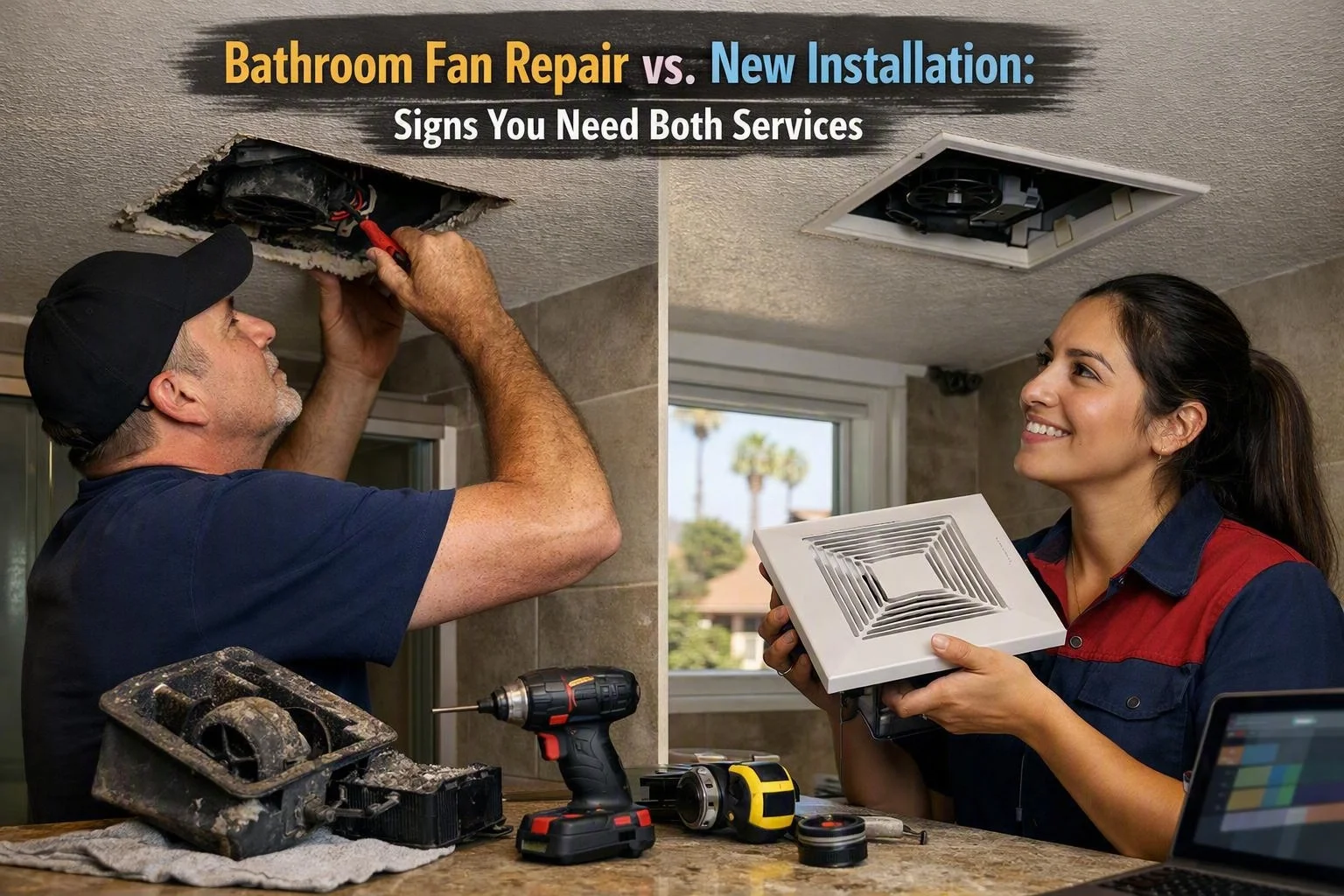
When Does a Bathroom Fan Need Repair or Replacement?
Bathroom fan repair fits a specific electrical or mechanical fault that we can safely correct, while replacement fits equipment or ventilation work that cannot be restored. We inspect the bathroom exhaust fan, fan motor, electrical wiring, wall switch and ventilation performance before choosing the service.
Repair may resolve a switch fault, loose wiring or a motor connection. Replacement becomes more suitable when the housing is damaged, the motor has failed, or the existing fan cannot move air through the available ductwork.
Repair and New Installation Compared
Bathroom fan repair addresses a recoverable fault, while new installation replaces unsuitable equipment or creates a properly supported fan system. The right choice depends on the fan assembly and the condition of the electrical and ventilation connections.
Our team compares the existing housing, circuit, ductwork and ceiling opening before recommending one service or both.
| Service | Primary purpose | Work we review |
|---|---|---|
| Bathroom fan repair | Corrects a serviceable fault | Fan motor, controls, wiring and circuit |
| Bathroom fan installation | Adds or replaces ventilation equipment | Housing, ceiling opening, duct connection and power supply |
| Combined project | Corrects the fault and completes a suitable system | Electrical circuit, replacement fan and ductwork |
Signs You May Need Both Services Together
Bathroom fan repair and new installation are both needed when correcting the immediate fault also requires replacing incompatible equipment or rebuilding the electrical or ventilation setup. We connect the repair decision to the condition of the complete bathroom exhaust system.
These conditions can make one service incomplete on its own. Our crew plans the electrical and ventilation work together so the finished system supports moisture control.
How Repair and Installation Work Together
Repair and installation work together by resolving unsafe or failed connections first, then fitting and testing equipment that matches the bathroom and ventilation system. We keep the project scope connected from diagnosis through operational testing.
Our process keeps the repair work from being separated from the installation requirements. That approach helps us address the cause of the problem and the performance of the replacement system.
What We Check Before Recommending Repair or Replacement
We check the fan assembly, electrical supply, controls, duct path and installation access before recommending repair, replacement or both. A fan that runs can still have weak airflow if the ductwork or exterior termination is blocked, loose or poorly connected.
Our electrical diagnosis includes fan operation, the motor, capacitor, switch, circuit and grounding. We also review ceiling access, the fan housing and the duct route so the recommendation fits the whole home ventilation system.
We use the condition of each part to decide whether repair preserves the installation or whether a bathroom fan replacement provides the safer and more effective result.
What Changes the Cost of a Combined Fan Project?
The cost of a combined bathroom fan project depends on the replacement equipment, electrical repairs, access conditions, ductwork and any ceiling or control changes. We provide Free Estimates Available after assessing the work.
A replacement fan with a compatible existing circuit may require less preparation than a project involving switch wiring, difficult circuit access or ceiling repairs. Duct connection problems and installation complexity can also expand the required scope.
Our quote scope explains the equipment, repair work, access needs and ventilation tasks included. This gives you a clear basis for approving the connected work.
How We Complete Bathroom Fan Repair or Replacement
We complete a combined fan project by diagnosing the existing system, repairing required electrical faults, installing compatible equipment and testing airflow and operation. Each step helps confirm that the replacement fan matches the bathroom and its ventilation path.
Free Estimates Available helps us define the work before installation begins. Our operational testing confirms that the fan, controls and ventilation path work together.
Which Bathroom Fan Service Fits Your Situation?
Bathroom fan repair fits a recoverable electrical or mechanical fault, new bathroom fan installation fits unsuitable or failed equipment, and both services fit projects where electrical correction and equipment replacement are connected.
A bathroom fan replacement may be appropriate when the motor, housing or ventilation performance cannot be restored. We use the condition of the circuit, wall switch, ductwork and ceiling access to choose a complete solution.
Contact San Bernardino Electrician for an assessment when the bathroom fan is noisy, not working, moving weak air or showing signs of moisture damage. We can review the electrical fault and ventilation problem as one project.
Questions About Bathroom Fan Repair and Replacement
Can a bathroom exhaust fan be repaired instead of replaced?
Yes, a bathroom exhaust fan can be repaired when the fault is specific and the existing equipment remains safe and suitable. San Bernardino Electrician checks the motor, switch, wiring, circuit and duct path before recommending repair.
Why is a bathroom fan noisy after installation?
A bathroom fan may be noisy after installation because of mechanical contact, an unstable housing, a poor duct connection or restricted airflow. We inspect the fan assembly and ductwork to identify the source before adjusting or replacing components.
Can a bathroom fan replacement require new wiring?
Yes, a bathroom fan replacement can require new wiring when the existing conductors, connections, switch arrangement or circuit do not support the replacement fan safely. We test the circuit and correct the wiring before completing the installation.
Does a bathroom fan need its own switch?
A bathroom fan may use its own wall switch or a compatible control arrangement based on the installation design. We check the switch wiring and circuit so the control method matches the fan and the bathroom needs.
What should be checked when a new bathroom fan has weak airflow?
Weak airflow from a new bathroom fan calls for checking the grille, duct connection, duct blockage, exterior vent termination and fan capacity. We perform operational testing to separate an equipment issue from a ventilation path problem.
Related Resources
When You Need a 24-Hour Electrician
Who It's ForBathroom Fan Repair for Families With Young Children
What to AvoidBathroom Fan Installation Mistakes: Venting, Wiring, and Moisture Problems to Avoid
Why It MattersBathroom Exhaust Fan Benefits: Moisture Control, Comfort, and Home Protection