Skip to content
Glossary

What is Branch Circuit?

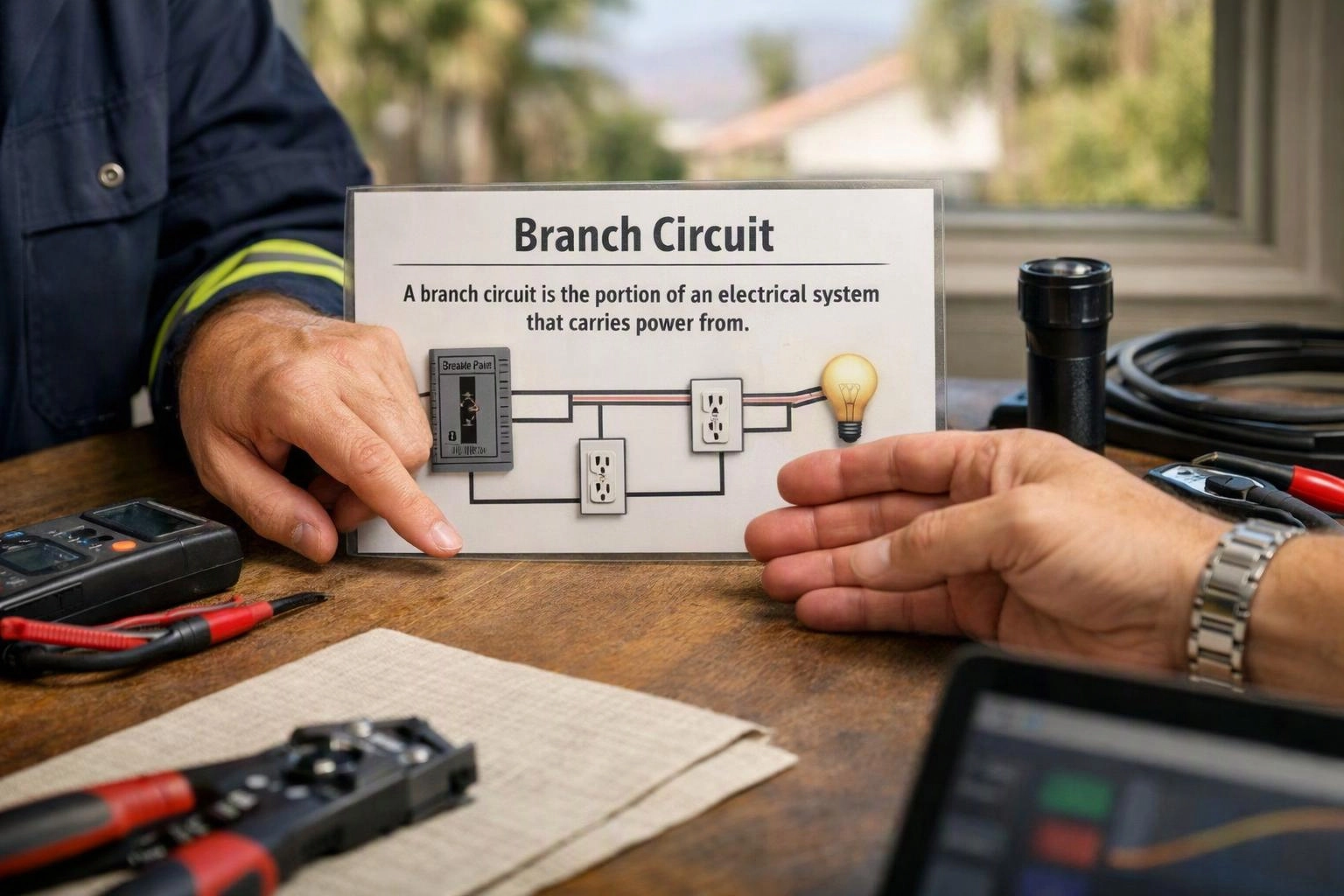
Branch Circuit is the portion of an electrical system that carries power from the final overcurrent device, such as a circuit breaker, to connected outlets, switches, and equipment. A branch circuit includes the conductors and equipment grounding conductor that serve a specific load area, appliance, room, or group of electrical devices.

Quick Facts About Branch Circuit

Category

Electrical distribution component

Used for

Supplying outlets, lighting, and equipment

Common confusion

A branch circuit is not the same as a feeder.

Relevant standard

NFPA 70, National Electrical Code

Also called

Branch circuit wiring, Final circuit

Often discussed with

Circuit Breaker Repair

Key Takeaways About Branch Circuit

  • A branch circuit runs from a circuit breaker or fuse to the devices it supplies.
  • Circuit rating, wire gauge, and connected load must match for safe operation.
  • Lighting, receptacles, and dedicated appliances may need separate branch circuits.
  • An overloaded branch circuit can trip the breaker, overheat wiring, or cause fire risk.
  • The National Electrical Code sets branch circuit installation and protection requirements.

Understanding Branch Circuit

SanBernardino-Electrician.com in San Bernardino — Understanding Branch Circuit

Branch Circuitdescribes wiring between the final overcurrent device and electrical loads. The device serves those loads. The final overcurrent device is usually.circuit breaker in an electrical panel. The circuit then runs through cable or conduit to outlets, switches, lights, or fixed equipment.

Related glossary terms: Circuit, Electrical Panel, Receptacle.

A branch circuit may supply one appliance or several devices in one area. A general-purpose circuit might serve room outlets and lights. A dedicated circuit supplies equipment such as an oven, air conditioner, or water heater. The circuit includes current-carrying conductors.equipment grounding conductor. This conductor provides a low-resistance path during a fault.

How Branch Circuit Works, Is Measured, or Is Used?

Electrical current leaves the panel on the ungrounded conductor. It returns on the grounded conductor in typical single-phase circuits. The circuit breaker limits current during a short circuit or lasting overload. A 120-volt circuit commonly uses one ungrounded conductor and one grounded conductor. It also uses one grounding conductor. The exact setup depends on the system and equipment.

Branch circuits have a voltage, ampere rating, conductor size, and purpose. A 20-ampere circuit generally needs conductors sized for that rating. Applicable code rules and installation conditions can affect this need. The connected load must stay within the circuit rating. Continuous loads may need more capacity.National Electrical Code. An electrician checks the panel labels, wire size, breaker rating, connections, and measured load. The electrician checks these items before changing a circuit.

  • General-purpose circuits serve multiple outlets or lighting points.
  • Individual branch circuits serve one specific load or appliance.
  • Multiwire branch circuits share a grounded conductor under defined installation conditions.

Why Branch Circuit Matters?

SanBernardino-Electrician.com in San Bernardino — service highlight — Why Branch Circuit Matters?

Branch circuit design affects safety, reliability, and equipment speed. An overloaded circuit can trip again and again. It can also heat its conductors or damage connected equipment. Loose terminals, damaged insulation, wrong breaker sizes, and shared loads increase the risk. The breaker may still seem to work normally.

Proper circuit separation also supports reliable operation. High-demand equipment can cause voltage drop or nuisance trips. This can happen when it shares a circuit with smaller loads. Required protection may apply based on location, occupancy, and circuit use. Examples include.ground-fault circuit interrupter or arc-fault circuit interrupter.

When Branch Circuit Matters Most?

Branch circuit planning matters during remodeling, appliance replacement, panel work, and troubleshooting. A new electric range, heat pump, workshop tool, or electric vehicle supply equipment may exceed an existing circuit's capacity. Adding outlets without checking the circuit rating can create an unsafe condition behind finished walls.

Older homes may contain changed wiring, shared neutrals, missing grounds, or mismatched fuse protection. Warning signs include warm receptacles, flickering lights, buzzing sounds, scorch marks, repeated breaker trips, and unexplained voltage changes. A proper check traces the circuit from the panel to each connected load. It also compares the installation with the applicable California Electrical Code and permit requirements.

How to Evaluate Branch Circuit?

  • Confirm that the breaker rating matches the conductor size and the circuit design.
  • Check whether the connected load fits the circuit ampere rating and continuous-load requirements.
  • Look for warm outlets, discoloration, buzzing, damaged insulation, or repeated breaker trips.
  • Verify required GFCI or AFCI protection for the circuit location and use.
  • Compare panel labels with the devices that lose power when the breaker is switched off.

Related Concepts Compared

Branch Circuit vs. Feeder

A feeder carries power from a service or distribution point to another panel or distribution equipment. A branch circuit continues from the final overcurrent device to the outlets or equipment.

Branch Circuit vs. Circuit

Circuit is a broad term for a complete electrical path. Branch circuit identifies the part of that path serving final loads after the last overcurrent device.

Branch Circuit vs. Dedicated Circuit

A dedicated circuit is a branch circuit intended for one appliance or piece of equipment. Not every branch circuit is dedicated. Since general-purpose circuits can supply multiple devices.

Expert Note

A breaker protects conductors from excessive current, but it does not prove that a branch circuit is correctly installed. An evaluation should also check connections, grounding, neutral sharing, voltage drop, device ratings, and required protective devices.

Common Mistakes or Myths About Branch Circuit

  • Installing a larger breaker without replacing conductors rated for the higher current.
  • Assuming one breaker means one outlet or one appliance.
  • Adding receptacles without checking the existing circuit load.
  • Ignoring repeated breaker trips instead of finding the underlying fault.
  • Treating a power strip as a substitute for a properly designed branch circuit.

Branch Circuit in Practice: A Real-World Example

A kitchen receptacle circuit supplies several countertop outlets. A new microwave may cause trips with a toaster. A dedicated branch circuit with the correct breaker, conductors, receptacle, and protection can prevent overloads when code requirements are met.

Related Terms

Circuit

Circuit is a complete path that carries electric current from a power source through connected equipment…

Electrical Panel

Electrical Panel is the main enclosure that receives electricity from a utility service and distributes it…

Receptacle

Receptacle is a wiring device that accepts a plug and provides electrical power to connected equipment…

Wire Gauge

Wire Gauge is a numbering system that identifies the diameter and current-carrying capacity of electrical wire…

SanBernardino-Electrician.com

Have Questions About Branch Circuit?

Contact SanBernardino-Electrician.com for practical guidance on Branch Circuit and related 24 hour electrician work in San Bernardino.

+1 (909) 271-0200