What is Short Circuit?
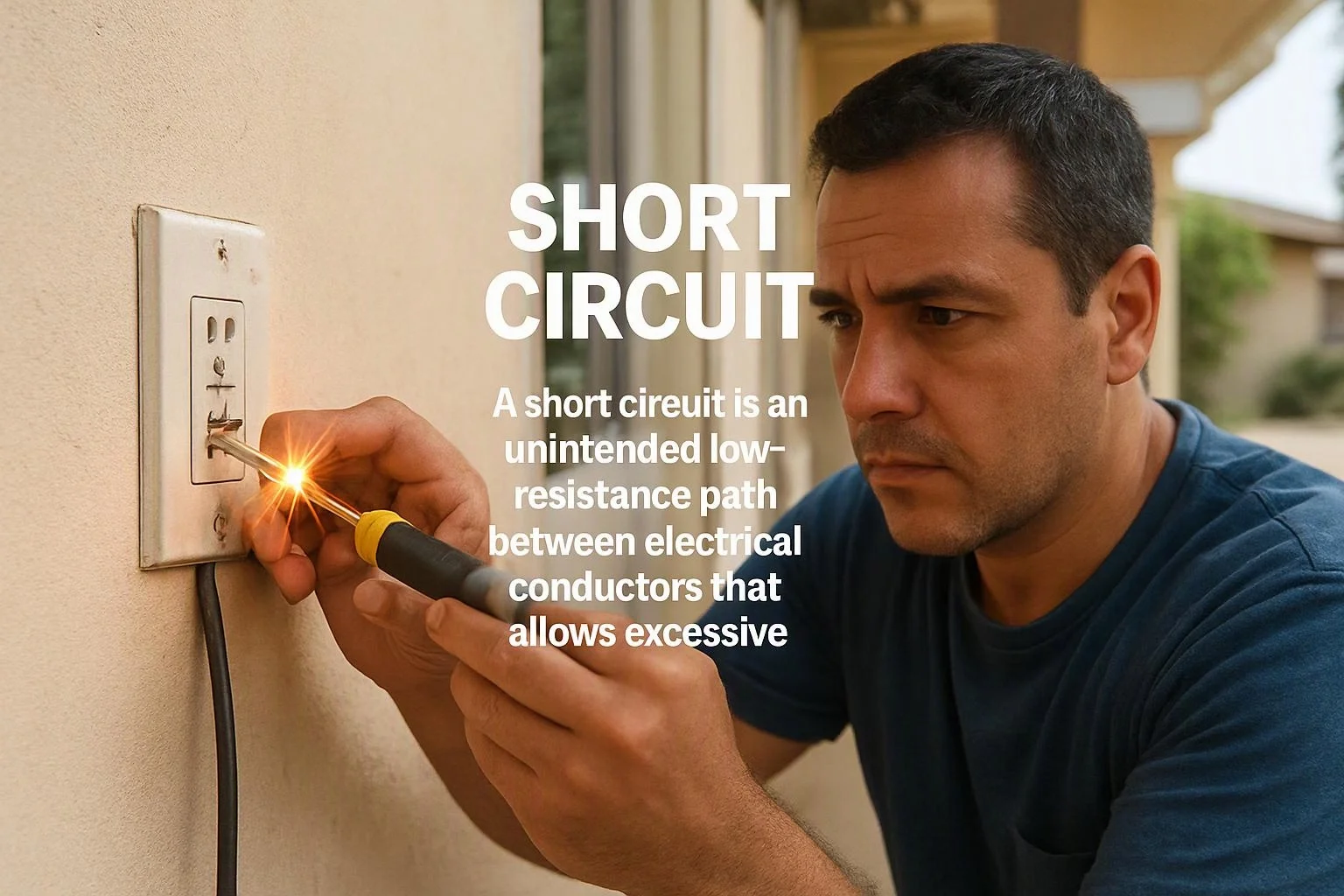
Short Circuit is an unintended low-resistance path between electrical conductors that allows excessive current to flow. The fault may connect a hot conductor to neutral, ground, or another hot conductor. Excess current can overheat wiring, trip a circuit breaker, damage equipment, create arcing, and start a fire if protective devices fail.
Quick Facts About Short Circuit
Category
Electrical fault
Formula
Fault current follows I = V ÷ R
Measured by
Voltage, resistance, continuity, and current tests
Main risk
Overheating, arcing, equipment damage, or fire
Relevant standard
National Electrical Code requirements for overcurrent protection
Also called
Electrical short, Shorted circuit
Key Takeaways About Short Circuit
- A short circuit creates an unintended path with much lower resistance than the normal load.
- Circuit breakers and fuses should interrupt fault current before wiring overheats.
- Burning smells, sparks, warm outlets, and repeated trips can indicate a short circuit.
- Never replace a tripping breaker with a larger one because that can overheat the wiring.
- Finding the fault requires testing, inspection, and safe isolation of the affected circuit.
Understanding Short Circuit

Short Circuit describes a fault with an unsafe path between conductors. This path has less resistance than the load. Current then rises fast. A fault may occur between a hot wire and neutral. It may occur between hot wires. It may also occur between a hot wire and grounded metal.
Related glossary terms: Circuit, Branch Circuit, Arc-Fault Circuit Interrupter.
Normal circuit wiring sends current through equipment such as a lamp, motor, or heater. That equipment limits current by adding resistance. Damaged wire insulation can bypass the equipment. A loose connection, crushed cable, failed appliance, or water intrusion can also create a fault. The resulting fault current may heat metal fast. It may also create an arc or flash.
How Short Circuit Works, Is Measured, or Is Used?
Electrical current follows the rule I = V ÷ R. I means current. V means voltage. R means resistance. If voltage stays the same and resistance nears zero, current rises greatly. The exact current depends on the power source and conductor size. It also depends on circuit length and total impedance. A household short doesn't always produce the same reading.
A circuit breaker or fuse finds excess current and opens the circuit. A breaker may use a thermal element, a magnetic trip, or both. A trained technician first switches off the affected circuit. The technician confirms that power is absent. Then the technician checks wires, receptacles, boxes, fixtures, and connected equipment. Tests may check resistance, continuity, insulation, and current. A multimeter or other rated tool may perform these tests.
Why Short Circuit Matters?

A short circuit can damage electrical equipment and wiring in less than one second. The fault may leave scorch marks or melt insulation. It may trip a breaker or cause an arc flash. Safety devices reduce the danger. They can't fix damaged wiring or a failed appliance.
Repeated breaker trips are a warning. They're not a problem to bypass. Resetting the breaker once may make sense after a short event. A second trip points to a fault or overload that remains. Installing a larger breaker changes the safety level. It may let the wires overheat.
When Short Circuit Matters Most?
The risk increases after remodeling, water leaks, pest damage, rodent chewing, or work on old wiring. Outdoor receptacles, kitchen tools, air-conditioning units, and packed junction boxes need close checks. A burning smell, buzzing, sparks, warm cover plate, or dark outlet needs quick shutdown. Shut down the affected circuit right away.
Repair choices depend on the fault location and wiring condition. The right repair may replace a damaged receptacle, appliance cord, cable section, breaker, or connection. Work should follow.National Electrical Code and local rules. A technician must check grounding, box fill, conductor size, and overcurrent protection. The circuit can return to service after these checks.
How to Evaluate Short Circuit?
- Identify whether the breaker trips immediately, only under load, or after running for several minutes.
- Inspect for soot, melted insulation, loose terminals, water damage, warm devices, and burning odors.
- Verify that the breaker rating matches the circuit conductor size and equipment requirements.
- Test disconnected loads separately to determine whether an appliance or fixed wiring causes the fault.
- Confirm that repaired wiring has correct polarity, grounding, insulation condition, and secure terminations.
Related Concepts Compared
Short Circuit vs. Overload
An overload occurs when connected equipment draws more current than a circuit should carry. A short circuit creates an unintended low-resistance path and often causes a faster, much larger current surge.
Short Circuit vs. Ground Fault
A ground fault is a type of fault in which current travels from an energized conductor to ground. A short circuit may involve ground, neutral, or another energized conductor.
Short Circuit vs. Arc Fault
An arc fault produces an unintended electrical arc through damaged or separated conductors. A short circuit may cause arcing, but not every short circuit creates a sustained arc.
Short Circuit vs. Open Circuit
An open circuit has a broken path, so current cannot flow normally. A short circuit has an unwanted path with very low resistance, so excessive current may flow.
Expert Note
A breaker that trips immediately after reset often points to a direct fault, while a delayed trip may involve an overload, heat, or a failing device. Testing should separate connected loads from fixed wiring before replacing parts.
Common Mistakes or Myths About Short Circuit
- Resetting a breaker repeatedly instead of finding the cause.
- Replacing a tripping breaker with one that has a higher amp rating.
- Assuming a short circuit always means the breaker or fuse is defective.
- Testing live wiring with an instrument that lacks the correct voltage rating.
- Ignoring heat, odor, discoloration, buzzing, or sparks around electrical devices.
Short Circuit in Practice: A Real-World Example
A homeowner plugs in a damaged vacuum cleaner, and the branch-circuit breaker trips at once. Inspection finds a crushed cord that connected the hot conductor to neutral. Replacing the cord and testing the circuit removes the short circuit without installing a larger breaker.
Sources & Further Reading on Short Circuit
Related Services
Related Terms
Circuit
Circuit is a complete path that carries electric current from a power source through connected equipment…
Branch Circuit
Branch Circuit is the portion of an electrical system that carries power from the final overcurrent…
Arc-Fault Circuit Interrupter
Arc-Fault Circuit Interrupter is a protective device that detects dangerous electrical arcing in branch-circuit wiring and…
Ground-Fault Circuit Interrupter
Ground-Fault Circuit Interrupter is a protective device that monitors current flowing through a circuit and quickly…
SanBernardino-Electrician.com
Have Questions About Short Circuit?
Contact SanBernardino-Electrician.com for practical guidance on Short Circuit and related 24 hour electrician work in San Bernardino.