
What Is An Ohm?
An ohm is the unit used to measure electrical resistance, which describes how strongly a material or circuit opposes current flow. Resistance affects how much current a given voltage can produce. Electricians use ohms when testing wires, components, and circuits for unwanted resistance, open paths, or shorted conditions.
Quick Facts About Ohm
Category
Electrical measurement unit
Used for
Testing resistance in circuits and components
Common confusion
An ohm does not measure voltage
Also called
Ohm unit, Ω
Often discussed with
Electrical Troubleshooting
Key Takeaways About Ohm
- An ohm measures resistance, not voltage or current.
- Higher resistance restricts current through a circuit.
- Resistance and continuity are related, but they are not identical tests.
How Ohm Works
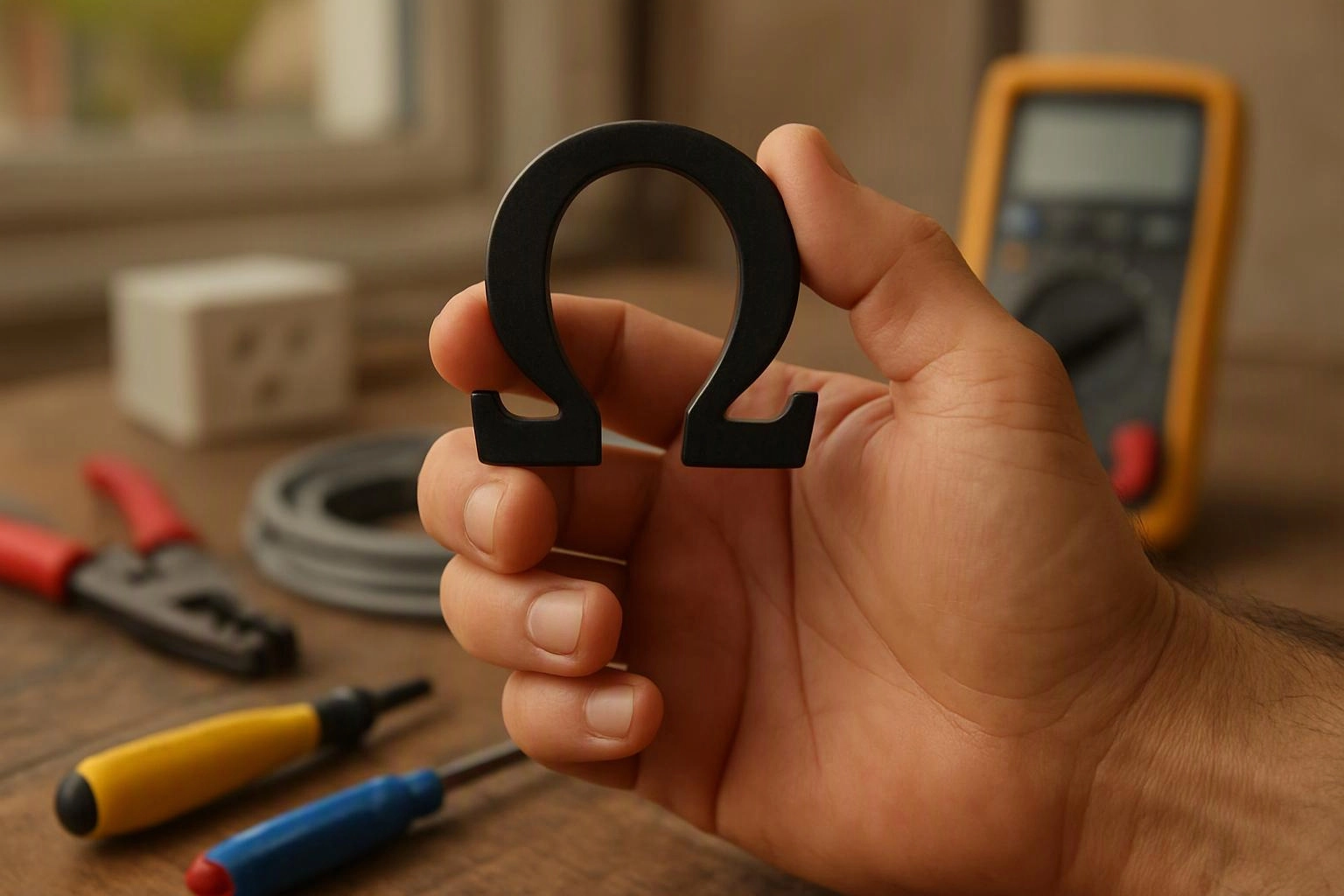
Ohm measures the resistance that limits current in an electrical path. Conductive materials offer lower resistance, while damaged connections, poor splices, or failed components can create unwanted resistance. A multimeter applies a small test signal and reports the resistance it detects.
Related glossary terms: Current, Continuity Test, Short Circuit.
Resistance helps an electrician interpret circuit behavior during troubleshooting. A very low reading may point to a continuous path or a shorted component, depending on the circuit design. A very high reading may indicate an open connection or a disconnected component. The test must be performed with the circuit de-energized, because an energized circuit can produce an inaccurate reading and damage the meter. Continuity testing focuses on whether a path exists, while resistance testing gives more detail about the path.
From the San Bernardino Electrician team
When we troubleshoot a circuit, we isolate power before measuring resistance. We check readings against the circuit layout and inspect connections when the result does not fit the expected path. Resistance testing can help us separate a broken conductor from a faulty component.
Ohm in Practice: A Real-World Example
During electrical troubleshooting, a wall switch may show an unexpected resistance reading when the circuit is de-energized. We trace the conductors and connections to determine whether the reading comes from the switch, a loose splice, or another part of the circuit.
Related Services
Related Terms
Current
Current is the movement of electric charge through a conductor, such as a wire, circuit path…
Continuity Test
A continuity test is an electrical check that determines whether a complete conductive path exists between…
Short Circuit
A Short Circuit is an unintended low-resistance path between electrical conductors that allows excessive current to…
Voltage Drop
Voltage Drop is the reduction in electrical pressure that occurs as current travels through a conductor…
San Bernardino Electrician
Have Questions About Ohm?
Contact San Bernardino Electrician for practical guidance on Ohm and related 24 hour electrician work in San Bernardino.