Signs Your Outdoor and Landscape Lighting Has Electrical Damage in San Bernardino, CA
Outdoor and landscape lighting wiring damage often appears as flickering lights, repeated breaker trips, burning smells, warm fixtures, exposed conductors, corrosion, or lights that fail after moisture; San Bernardino Electrician checks the circuit, connections, fixtures, and grounding to identify the fault and complete safe repair.
Get a Free Estimate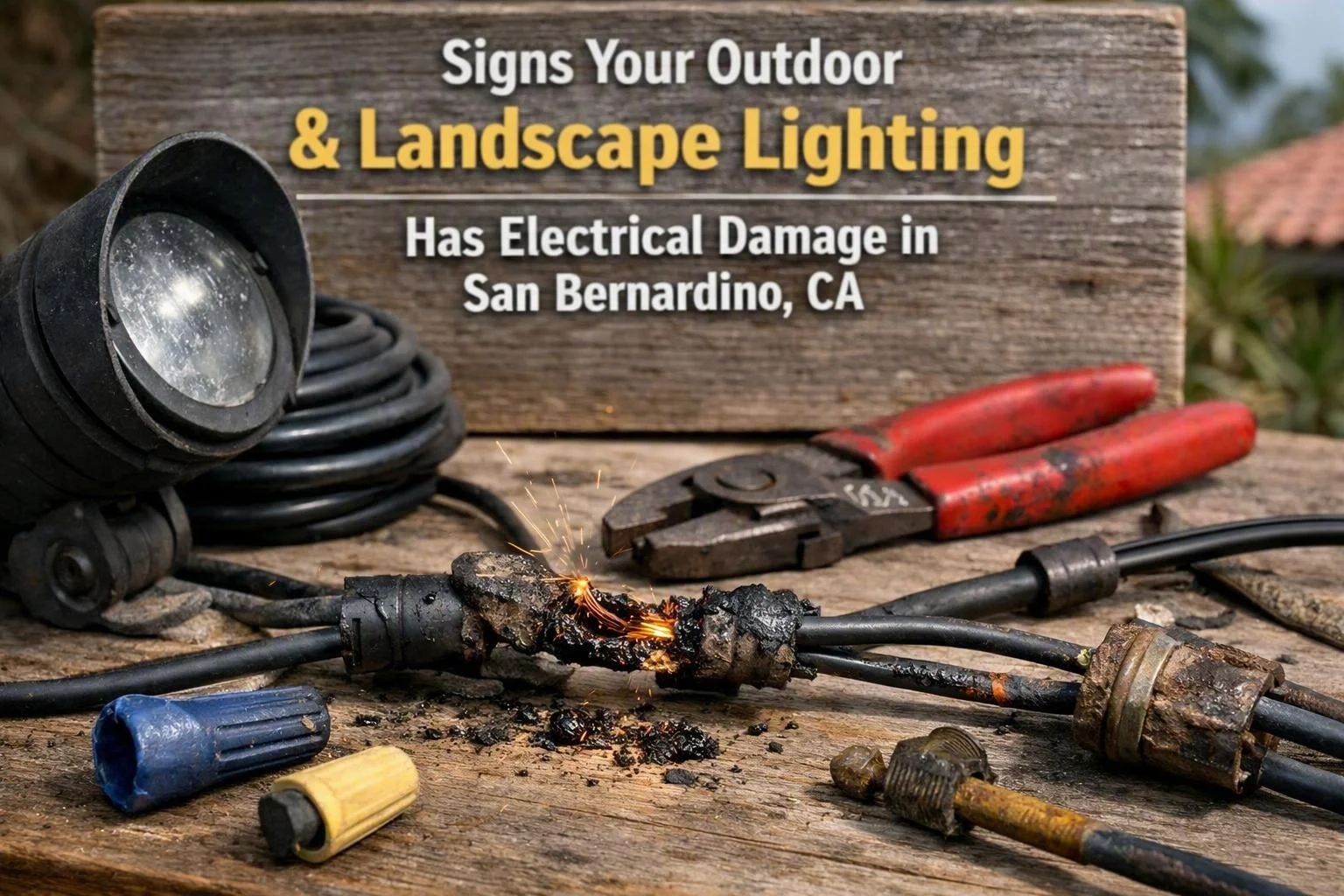
Outdoor lighting wiring can show electrical damage through visible, operational, thermal, and circuit warning signs that require troubleshooting or repair. We connect each sign to the likely fault and the safest next step.
What Are the Signs Your Outdoor Lighting Wiring Is Bad?
Bad outdoor lighting wiring can cause flickering, repeated breaker trips, burning odors, warm fixtures, visible conductor damage, corrosion, and failures after moisture exposure. Our team uses these clues to decide where electrical troubleshooting should begin.
Check the lighting system without touching damaged parts or opening energized equipment. The warning signs below can point to problems in the wiring, fixtures, connections, or circuit.
Why Do Outdoor and Landscape Lights Develop Electrical Damage?
Outdoor lighting electrical damage develops when moisture, physical impact, deteriorated insulation, loose connections, or circuit demand weakens the wiring system. Our team traces the issue through the landscape lighting circuit instead of assuming the light fixture is the only problem.
Moisture intrusion can affect light fixtures, wire connections, and junction boxes. Physical damage can affect buried cable or fixture lead wires. We inspect these points for corrosion, damaged insulation, and signs of a short circuit.
Grounding also matters because outdoor equipment needs a reliable path for fault current. In lower-elevation developed areas, hot, dry summers can increase electrical demand and expose weaknesses in breakers, panels, wiring, and dedicated circuits connected to the lighting system.
Foothill and upland properties can face stronger wind and dry vegetation conditions. We give exposed outdoor electrical equipment a careful safety assessment when those conditions may affect the lighting installation.
What Should You Do When Outdoor Lighting Wiring Shows a Warning Sign?
Turn off the affected lighting circuit when you notice heat, burning odors, sparking, or exposed wiring, and contact San Bernardino Electrician for electrical troubleshooting and repair. Do not handle damaged conductors, wet fixtures, or loose connections.
Use the circuit breaker only when you can identify the affected circuit safely. Keep people away from damaged outdoor lighting equipment, and avoid switching the circuit back on to test it.
We can inspect the outdoor lighting fixture, circuit, connections, and grounding to identify the fault. Our Landscape Lighting Repair service focuses on safe fault location and repair decisions.
What Can You Do Yourself, and When Should We Inspect the Wiring?
A safe visual check and basic control check are reasonable homeowner tasks when the lighting circuit is off and the equipment is easy to reach. San Bernardino Electrician should handle energized circuit testing, damaged wiring, grounding faults, and concealed connections.
Do not remove covers, dig for buried cable, or test live conductors. Our crew uses circuit testing and fixture inspection to locate faults without turning an unsafe condition into a larger hazard.
| Factor | What you can do yourself | What we do |
|---|---|---|
| Visual condition | Look for exposed wires, cracked insulation, corrosion, moisture, or physical damage with power off. | We inspect fixtures, connections, junction boxes, and accessible wiring for the source of damage. |
| Lighting controls | Confirm the switch, timer, transformer control, or other basic control operates normally. | We test the lighting circuit and separate control problems from wiring or fixture faults. |
| Circuit testing | Reset a tripped breaker only when the cause is not obvious and the area is dry and safe. | We perform energized testing, check the circuit breaker, and trace shorts or loose connections. |
| Grounding | Do not disturb grounding conductors or open electrical equipment. | We inspect electrical grounding and correct grounding faults as part of safe repair. |
| Wiring repair | Keep the circuit off and mark the unsafe area for others. | We repair damaged wiring, connections, junction boxes, or fixture leads as needed. |
How We Diagnose Outdoor Lighting Electrical Damage
Our electrical troubleshooting process identifies whether the fault is in the circuit breaker, wiring, connections, fixture, or grounding. We inspect the system according to its voltage type and installation layout.
What Does Landscape Lighting Repair Include?
Landscape lighting repair can include locating the fault, repairing damaged wiring or connections, correcting fixture problems, and checking safe circuit operation. Our crew matches the repair to the condition we find during testing.
Wiring repair may involve a damaged conductor, loose connection, junction box, or fixture lead wire. Fixture replacement may be appropriate when the light itself has failed, while connection repair may restore operation when the fixture remains serviceable.
Lighting Repair also includes checking the affected circuit and electrical grounding after the work. We explain the repair decision before completing the safe electrical repair.
What Changes the Cost of Repairing Bad Outdoor Lighting Wiring?
The repair cost depends on the fault location, wiring accessibility, circuit configuration, fixture condition, and whether the system needs repair or replacement; Free Estimates Available from San Bernardino Electrician provide job-specific pricing.
A visible fixture connection may require a different repair approach from concealed wiring or a damaged landscape lighting circuit. The condition of the junction box, grounding, breaker, and other connected equipment can also change the work involved.
We inspect the affected system and explain what the estimate covers, including fault location, wiring repair, fixture work, connection repair, and circuit checks that apply to the job.
When Can a Lighting Fault Require More Than Fixture Repair?
A lighting fault can require broader electrical work when testing identifies a breaker, circuit, grounding, panel, or property-protection problem beyond the fixture itself. We trace the fault far enough to determine whether the lighting system is affected by a larger electrical issue.
A dedicated circuit may be relevant when circuit demand or configuration contributes to repeated breaker trips. Panel repair, wiring repair, or electrical grounding work may be needed when those parts fail testing.
Lightning Rod Installation can be a separate property-protection discussion when outdoor electrical equipment is part of a broader exposure concern. We keep that decision separate from fixture repair and base it on the condition of the property and electrical system.
Questions About Outdoor Lighting Wiring Damage
Can bad outdoor lighting wiring cause a breaker to trip?
Yes, bad outdoor lighting wiring can cause a breaker to trip when a short circuit, overload, damaged insulation, moisture, or a failing connection affects the circuit. San Bernardino Electrician tests the breaker, wiring, fixtures, and grounding to locate the cause.
Can outdoor lighting wiring be repaired without replacing the fixtures?
Yes, outdoor lighting wiring can be repaired without replacing the fixtures when testing shows that the fixtures remain serviceable. We repair the damaged conductor, connection, junction box, or fixture lead wire and then check safe operation.
How can I tell whether the problem is the landscape light or the wiring?
The problem is more likely to involve wiring when several lights flicker, the breaker trips, connections show corrosion, or failures follow moisture. We use circuit testing and fixture inspection to separate a failed landscape light from a wiring fault.
Should outdoor lights be turned off when the wiring smells hot?
Yes, outdoor lights should be turned off at the circuit breaker when the wiring smells hot, the fixture feels warm, or sparking is present. Keep away from the equipment and contact us for safe electrical repair.
What does San Bernardino Electrician check during landscape lighting repair?
San Bernardino Electrician checks the landscape lighting circuit, circuit breaker, wire connections, light fixtures, junction boxes, damaged insulation, and electrical grounding during landscape lighting repair.
Contact San Bernardino Electrician when outdoor lighting wiring flickers, trips the breaker, smells hot, shows damage, or fails after moisture exposure. We inspect the system, explain the repair path, and provide a job-specific estimate.
Get a Free EstimateRelated Resources
Electrical Sparks From an Outlet, Switch, or Panel: Emergency Repair Guide
What It SolvesCeiling Fan Not Working: Electrical Faults and Repair Solutions
Who It's ForEmergency Lighting Repair for Seniors in San Bernardino, CA
Who It's ForRetail Store Lighting Repair and Circuit Service in San Bernardino, CA