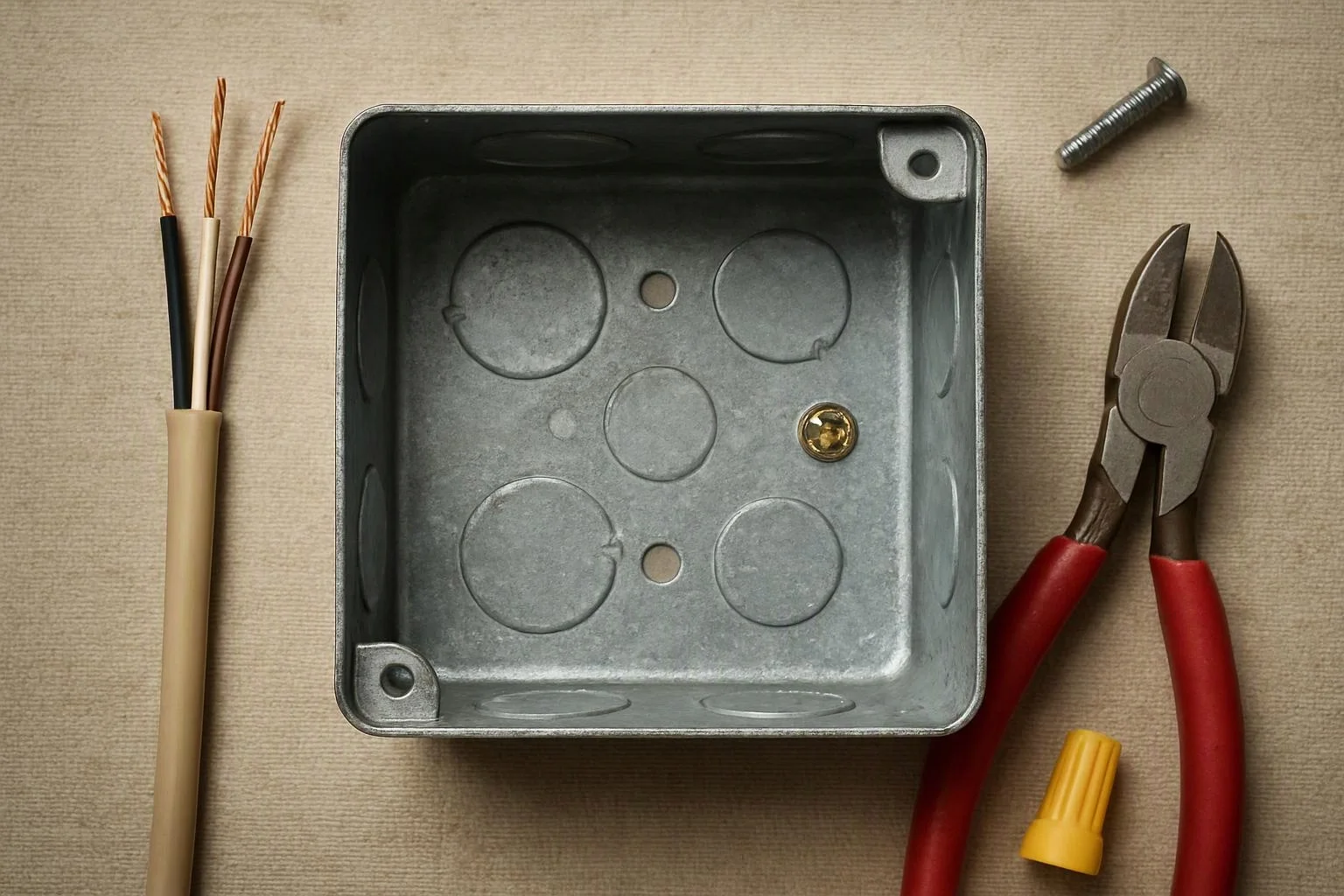
What is Junction Box?
Junction Box is an enclosed electrical container that protects wire connections where two or more cables meet, branch, or change direction. The box prevents accidental contact with energized conductors, limits damage from impact, and provides a serviceable location for inspection and repair. Covers must remain accessible and properly secured after installation.
Quick Facts About Junction Box
Category
Electrical wiring enclosure
Used for
Protecting wire splices and branch connections
Common confusion
A junction box is not the same as an electrical panel
Relevant standard
National Electrical Code, Article 314
Also called
Splice box, Electrical junction box
Often discussed with
Lighting Installation, Lighting Repair
Key Takeaways About Junction Box
- A junction box protects wire splices from contact, impact, moisture, and other physical damage.
- The box must match the conductor count, wire size, device type, and installation location.
- Every junction box needs an approved cover that remains accessible after installation.
- Electrical boxes are not automatically junction boxes, because some only support switches, outlets, or fixtures.
Understanding Junction Box

Junction Box is an enclosure that holds and protects electrical wire connections. Conductors may enter through cable clamps, conduit fittings, or listed connectors. Inside the box, electricians join wires with approved wire connectors, terminal blocks, or other listed devices. A cover closes the enclosure and helps prevent accidental contact with live parts.
Related glossary terms: Branch Circuit, Conduit, Electrical Code.
A junction box may be made from steel, PVC, fiberglass, or another listed material. Metal boxes need proper bonding and grounding when the installation requires it. Plastic boxes don't provide a grounding path. So the grounding conductor must continue through the box. It must connect to the equipment grounding means. The box must also suit the environment, such as a dry indoor area or a damp exterior location.
How Junction Box Works, Is Measured, or Is Used?
Junction boxes work by creating a protected space. This space holds a splice, a branch circuit, or a change between conduit and cable. An electrician brings each conductor into the enclosure through a listed entry point. The electrician leaves enough conductor for service work. The electrician makes connections according to the wiring plan. The cover stays removable so a qualified person can inspect or repair the connections later.
Box size matters because conductors and fittings occupy space. The National Electrical Code uses box-fill rules to determine the required volume. The calculation considers conductor count, conductor size, internal clamps, grounding conductors, and devices mounted inside the box. A crowded box can damage insulation and loosen connections. It can also increase heat. A larger box may be necessary, even when a smaller box appears to fit.
- Check the box volume marking and compare it with the calculated conductor volume.
- Use listed cable connectors or conduit fittings at each entry point.
- Keep all splices inside the box and install a properly fitted cover.
Why Junction Box Matters?

Junction boxes reduce the chance of hazards. A loose splice, damaged conductor, or exposed terminal can cause shock or fire. The enclosure also protects connections from movement and accidental impact. A secure connection has firm mechanical contact and enough insulation. A poor connection can create resistance and heat as current flows.
Good box selection helps an electrician trace a circuit. It also helps complete later repairs without opening walls unnecessarily. Clear labeling, accessible placement, and orderly conductor routing make troubleshooting faster. A junction box doesn't correct an overloaded circuit, damaged wiring, or an improper breaker size. Those conditions still require separate evaluation.
When Junction Box Matters Most?
Junction boxes become especially important during remodels, service repairs, lighting changes, and wiring extensions. A splice hidden behind drywall, insulation, or a finished ceiling is difficult to inspect. It may also violate local requirements. Accessible placement allows testing and repair while preserving the building finish.
Pay close attention when an existing box shows heat marks, corrosion, cracked insulation, loose covers, or signs of water entry. The box may also be too small for added conductors. It may lack a suitable connector at a cable entry. Before changing a connection, turn off the circuit. Verify the absence of voltage with an appropriate tester. Follow the applicable electrical code and local inspection requirements.
How to Evaluate Junction Box?
- Verify that the box has enough listed volume for every conductor, clamp, grounding conductor, and device inside.
- Check that each cable or conduit entry has an approved connector with no exposed sharp edges.
- Confirm that the cover fits securely and remains accessible without removing permanent building finishes.
- Look for heat damage, corrosion, loose splices, damaged insulation, or water entering the enclosure.
- Ask whether the box material and cover suit the location, wiring method, and grounding requirements.
Related Concepts Compared
Junction Box vs. Electrical Panel
An electrical panel distributes power through breakers or fuses and usually contains overcurrent protection. A junction box mainly encloses wire connections and normally does not contain circuit breakers.
Junction Box vs. Pull Box
A pull box provides space for pulling and routing conductors through conduit. A junction box may contain splices, while a pull box often contains continuous conductors without connections.
Junction Box vs. Outlet Box
An outlet box supports a receptacle, switch, or other device at an accessible location. A junction box primarily protects connections, although some boxes can serve more than one function when listed for that use.
Junction Box vs. Wire Nut
A wire nut is a connector used to join conductors. A junction box is the enclosure that protects the connector and the connected conductors.
Expert Note
A box that fits physically may still fail the box-fill calculation. Count grounds, internal clamps, cable entries, and devices before selecting the enclosure. Also check whether the cover remains accessible after insulation, drywall, or other finish materials are installed.
Common Mistakes or Myths About Junction Box
- Hiding a junction box behind drywall, paneling, insulation, or another permanent finish.
- Stuffing too many conductors into a box without checking the box-fill calculation.
- Leaving cable entries unsecured or using a connector that is not listed for the wiring method.
- Treating a wire nut as protection without placing the splice inside an approved enclosure.
- Installing a metal box without providing the required bonding or grounding connection.
Junction Box in Practice: A Real-World Example
A remodel adds a ceiling light to an existing branch circuit. The electrician places the splice between the old cable and the new cable inside an accessible junction box, secures both cable entries, connects the grounding conductors, and installs a listed cover. The connection remains protected and available for future inspection.
Sources & Further Reading on Junction Box
Related Services
Related Terms
Branch Circuit
Branch Circuit is the portion of an electrical system that carries power from the final overcurrent…
Conduit
Conduit is a protective raceway that contains and routes electrical conductors. Conduit may be made from…
Electrical Code
Electrical Code is a set of enforceable safety rules for designing, installing, inspecting, and maintaining electrical…
National Electrical Code
National Electrical Code is a safety standard published by the National Fire Protection Association that sets…
SanBernardino-Electrician.com
Have Questions About Junction Box?
Contact SanBernardino-Electrician.com for practical guidance on Junction Box and related 24 hour electrician work in San Bernardino.