
What is a Circuit?
Circuit is a complete path that carries electric current from a power source through connected equipment and back to the source. A circuit normally includes conductors, overcurrent protection, switches, and loads such as lights or receptacles. The circuit must remain continuous for current to flow, while a break or fault changes its operation. For more detail, see Signs You Need Circuit Breaker Repair in San Bernardino, CA.
Quick Facts About Circuit
Category
Electrical system path
Measured by
Voltage, current, resistance, and power
Used for
Delivering electricity to connected loads
Common confusion
A circuit is not the same as a circuit breaker
Also called
Electrical circuit, Electric circuit
Often discussed with
Circuit Breaker Repair
Key Takeaways About Circuit
- A complete circuit needs a source, conductors, a load, and a return path.
- Circuit breakers protect conductors by opening the circuit during excessive current.
- A branch circuit supplies power from an electrical panel to outlets, lights, or equipment.
- Voltage pushes current, while resistance limits current through the circuit.
- Short circuits create unintended low-resistance paths and can produce dangerous heat.
Understanding Circuit

Circuit describes a complete electrical path. The path starts at a source. It moves through conductors and a load. It then returns to the source. A utility service, battery, or generator can provide the source. A lamp, motor, appliance, or receptacle can act as the load. Current flows only when the path remains electrically continuous.
Related glossary terms: Branch Circuit, Electrical Panel, Short Circuit.
A typical building circuit includes hot conductors, a neutral conductor where required, and equipment grounding conductors. The hot conductor carries energy toward the load. The neutral conductor normally carries current back to the source. This applies in a single-phase system. The grounding conductor provides a low-impedance fault path. This path helps protective devices open the circuit quickly. Not every circuit uses a neutral. Grounding doesn't replace a neutral conductor.
How Circuit Works, Is Measured, or Is Used?
Electrical behavior depends on voltage, current, resistance, and power. Ohm's law shows their relationship.V = I × R. Voltage is measured in volts. Current is measured in amperes. Resistance is measured in ohms. Power follows the relationship P = V × I. Power is measured in watts. For example, a 120-volt load drawing 5 amperes uses about 600 watts.
In a home, power leaves the electrical panel through a circuit breaker. It travels along a branch circuit. A switch may control the load. Receptacles or fixtures connect equipment to the circuit. The breaker rating, conductor size, insulation rating, and installation method must match the design. A breaker doesn't increase the circuit's capacity. A larger breaker can let conductors overheat.
Why Circuit Matters?
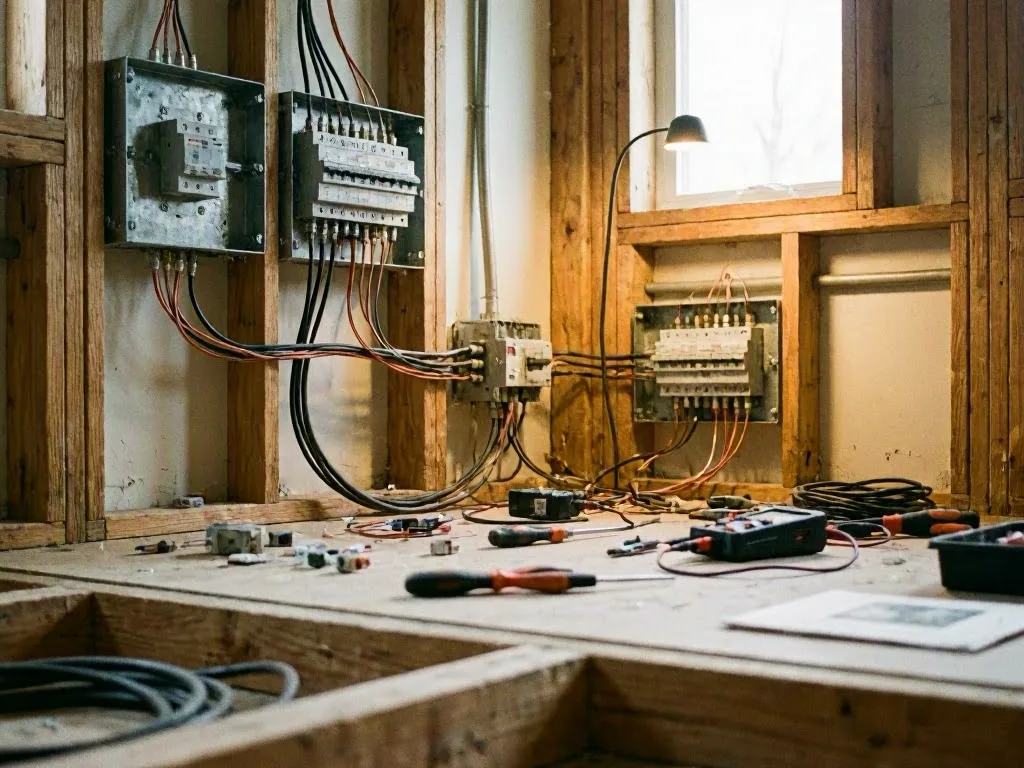
Correct circuit design keeps equipment operating. It also limits fire and shock hazards. Each circuit has a planned load capacity. This capacity depends on conductor size and installation conditions. It also depends on voltage and protective-device rating. Excessive load can trip a breaker. It can overheat connections. It can also cause voltage drop. Voltage drop affects motors and electronic equipment.
Protective devices add different types of protection. A ground-fault circuit interrupterresponds to current leaving the intended path. This helps protect people where shock risks exist.arc-fault circuit interrupter detects certain dangerous arcing conditions. A standard breaker mainly protects conductors from overcurrent. One device doesn't replace the others.
When Circuit Matters Most?
Circuit planning becomes important during remodeling and appliance installation. It also matters during panel replacement and troubleshooting. A new air conditioner, electric vehicle charger, range, or workshop tool may need a dedicated circuit. The available service capacity must support the added load. It must do so without excessive voltage drop or repeated breaker trips.
Inspection and repair require attention to warning signs. Frequent trips, warm receptacles, flickering lights, buzzing, burning odors, damaged insulation, and discoloration can signal problems. These signs can indicate loose connections, overloads, or faults. Turn off power before any authorized work. Don't keep resetting a breaker that trips repeatedly. The National Electrical Code provides installation rules. Local authorities enforce the adopted code edition and permit requirements.
How to Evaluate Circuit?
- Check whether the breaker rating matches the conductor size and the intended circuit load.
- Measure voltage at the source and load to identify excessive voltage drop or a loose connection.
- Confirm that grounding and bonding connections are present, tight, and continuous.
- Look for repeated breaker trips, warm devices, buzzing, discoloration, or burning odors.
- Verify required GFCI or AFCI protection based on the circuit location and equipment.
Related Concepts Compared
Circuit vs. Circuit Breaker
A circuit breaker is a protective switching device within a circuit. A circuit is the complete path that supplies and returns electrical current.
Circuit vs. Branch Circuit
A branch circuit is a specific type of circuit that runs from the final overcurrent device to outlets or loads. Circuit is the broader term.
Circuit vs. Short Circuit
A short circuit is an unintended low-resistance connection that allows excessive current. It is a fault condition, not the normal meaning of circuit.
Circuit vs. Electrical Loop
Electrical loop is an informal description of a complete current path. Circuit is the standard technical term and also includes its conductors, protection, switching, and loads.
Expert Note
A circuit can appear functional while still having a serious defect. Loose terminations may pass normal current yet heat under load, and a shared neutral can create problems when multiwire circuit conductors are not correctly arranged and disconnected together.
Common Mistakes or Myths About Circuit
- Replacing a frequently tripping breaker with a larger breaker without checking conductor size.
- Assuming a circuit is dead because one switch or receptacle does not work.
- Treating the grounding conductor as a substitute for the neutral conductor.
- Adding multiple high-power appliances to a general-purpose circuit.
- Resetting a breaker repeatedly without finding the cause of the trip.
Circuit in Practice: A Real-World Example
A bedroom lighting circuit leaves the electrical panel through a 15-ampere breaker, travels through cable to a wall switch, and reaches a ceiling fixture. Turning on the switch completes the path, allowing current to reach the lamp and return through the circuit conductors.
Sources & Further Reading on Circuit
Related Services
Related Terms
Branch Circuit
Branch Circuit is the portion of an electrical system that carries power from the final overcurrent…
Electrical Panel
Electrical Panel is the main enclosure that receives electricity from a utility service and distributes it…
Short Circuit
Short Circuit is an unintended low-resistance path between electrical conductors that allows excessive current to flow…
Voltage
Voltage is the electrical potential difference that pushes electric charge through a circuit. Measured in volts…
SanBernardino-Electrician.com
Have Questions About Circuit?
Contact SanBernardino-Electrician.com for practical guidance on Circuit and related 24 hour electrician work in San Bernardino.